 Executive Summary
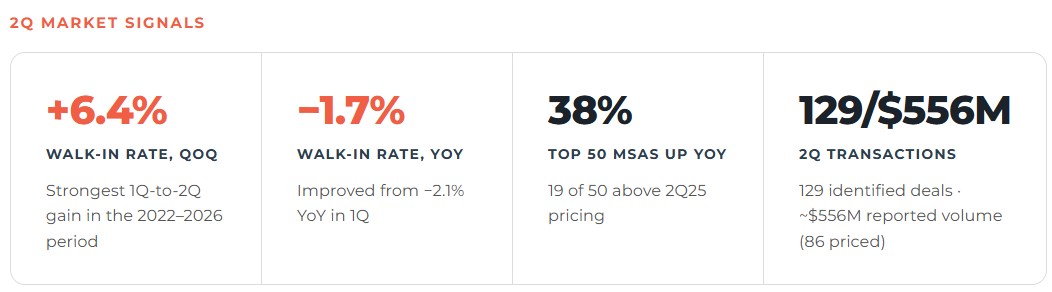
The U.S. self-storage market entered the second quarter with clearer signs of improvement, but the recovery remained uneven. National walk-in rates for non-climate-controlled (NCC) benchmark units increased 6.4% from the first quarter, the strongest first-to-second-quarter gain over the past four years. Still, pricing remained 1.7% below 2Q 2025, and only 19 of the Top 50 MSAs finished the quarter above prior-year levels. The result shows a market that is gaining momentum without yet showing a broad-based pricing recovery.
Existing supply continues to help explain why performance varies so widely by market. The least supplied third of the Top 50 posted median year-over-year walk-in rate growth of 2.2%, compared with a 5.7% decline among the most-supplied third. That relationship was meaningful but far from uniform, reinforcing that local demand, operator strategy and other market-specific conditions remain important drivers of performance.
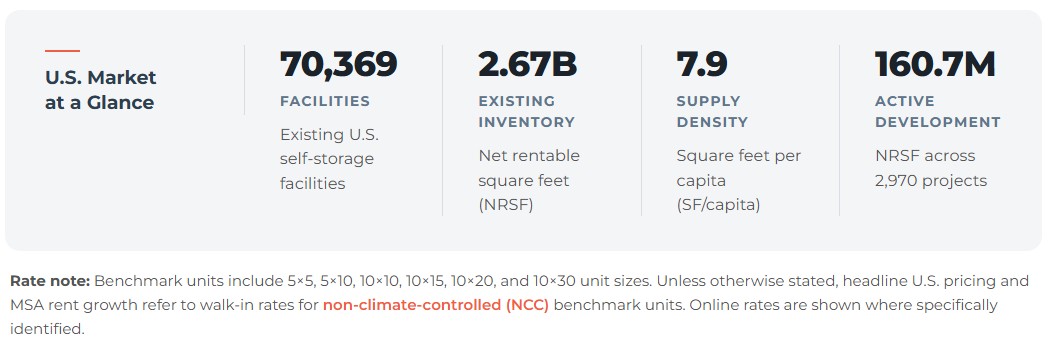
Development remains substantial at 160.7 million net rentable square feet (NRSF) across 2,970 active projects, but the near-term competitive impact is more limited than the headline pipeline suggests. Only 42.7 million NRSF is currently under construction, and relatively little space is scheduled to open during the remainder of 2026. Current pricing was more closely tied to the supply already on the ground than to the development pipeline, showing that markets with larger pipelines were not necessarily those experiencing the greatest pricing pressure.
Public-operator results add another important layer to the 2Q story. Occupancy increased across 90% of comparable REIT markets, while rent growth was considerably less widespread. The divergence shows that operators have continued to maintain high occupancy even as pricing power remains constrained in many markets.
Transaction activity remained broad but unevenly priced. StorTrack identifies 129 transactions in 2Q, of which 86 carried disclosed pricing totaling approximately $556 million. Larger transactions accounted for a disproportionate share of reported dollars, though that concentration has eased as smaller deals completed recording. Parking-inclusive properties represented 46% of identified single-asset transactions, reinforcing the importance of boat, RV, and vehicle storage within the sector.
Overall, 2Q marked a meaningful improvement from the start of the year. Pricing regained momentum, occupancy remained strong, and several markets posted higher rates than a year ago. However, the U.S. average remained negative year-over-year and performance varied considerably by market, pointing to improving conditions rather than a fully established recovery.
Download the full report to dig into:
- Which markets posted double-digit rate gains and which fell the hardest
- Where the development pipeline is most concentrated and what that means for 2028
- Why Boat, RV, and vehicle storage is telling a different pricing story than conventional self-storage
- What 129 transactions in 2Q say about where capital is moving
- How REIT occupancy and rent trends are pointing in opposite directions
Explore Self-Storage Market Dynamics Across the U.S.
Access pricing and market intelligence across 70,000+ U.S. facilities. Analyze rates, supply, and competitive positioning in the specific markets that matter most to you.
About StorTrack
StorTrack, a Green Street company, provides market intelligence for the self-storage, RV, and boat storage industries. With coverage of 80,000+ facilities across the U.S. and Canada, and additional coverage spanning the UK, Europe, Australia, and New Zealand, StorTrack gives operators, investors, brokers, lenders, and developers access to the data they need to understand market conditions, track competition, and make informed decisions. StorTrack’s platforms deliver current and historical rate data, supply and development tracking, and transaction intelligence across global markets.
The Voice Behind the Data
.jpg)
Christine Wachsman
Director of Market Analytics
Christine Wachsman is the Director of Market Analytics at StorTrack, leading market intelligence across self-storage and outdoor hospitality. As a former economist and lead analyst, she collaborated with institutional and corporate clients. Today, her market insights drive investment strategy across the commercial real estate spectrum, including multifamily, office, industrial, and data centers. She has also served as a panelist and committee member with organizations focused on advancing real estate analytics and has contributed to industry research and publications.