There’s a version of self-storage investing where you don’t have to pay close attention to the market. You buy a facility, keep occupancy reasonably high, and the fundamentals of the asset class do the heavy lifting. For most of the last two decades, honestly that approach worked fine. But times are changing.
The last three years reshuffled every assumption the industry ran on. Interest rates doubled in eighteen months and stayed there. A historic construction wave ran headlong into normalizing post-pandemic demand.
The REITs perfected the art of getting new tenants with low rates and raising them aggressively after move-in, but they’ve now found themselves staring down legislation in multiple states. Bridge loans originated at 3–4% floating are now maturing into a 6%+ world, and owners who can’t refinance are being forced to sell.
If you’re involved in self-storage right now, understanding what’s actually happening isn’t optional. It’s the difference between finding new opportunities in a recovering market and getting left behind.
The good news: the picture is getting clearer. Supply is finally contracting. Transaction volume is recovering. The operators who held discipline through the trough are beginning to pull away. And the maturity wall that’s causing real pain for overleveraged owners is simultaneously creating one of the best acquisition windows the industry has seen in a decade.
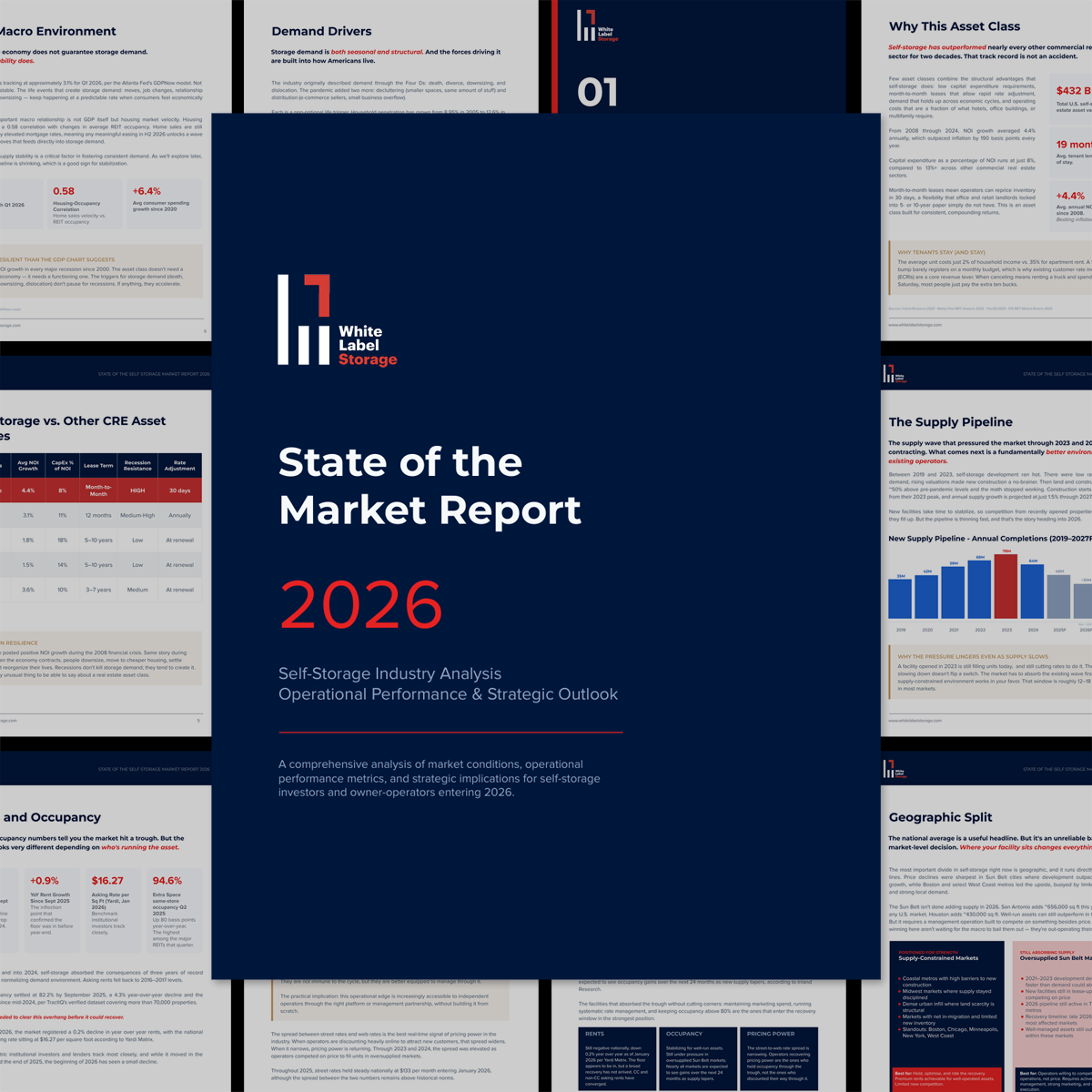
We analyzed all the trends that matter in the industry and compiled them in one report:
The 2026 State of the Self-Storage Market Report covers the full picture, from market fundamentals, operational realities, capital markets dynamics, and what to actually do with all of it.

1. Market Fundamentals
The long-run case for self-storage remains intact: 4.4% average annual NOI growth since 2008, low capex requirements, month-to-month leases that allow rapid repricing, and demand that holds up through recessions. But the current market is more nuanced than the long-run average suggests. Learn where rents and occupancy actually stand today, what the supply pipeline looks like through 2027, and which geographies are positioned for recovery versus which ones still need patience.
2. Operations & the Competitive Reality
As of Q4 2025, Extra Space same-store occupancy averaged 92.6%. The national average sat at 82.2%. That gap isn’t just about location; it’s also an operations story. This section explains exactly how institutional operators generate that edge, what regulatory risk is now landing on aggressive rate practices, and what it actually takes for independent operators to close the gap.
3. Capital Markets & the Acquisition Window
Roughly $875 billion in commercial real estate debt matures in 2026. Owners who can’t refinance are selling because they’re being priced off their balance sheet situation, not the long-term value of the asset.
This section explains what the lending landscape looks like now, the three refinancing scenarios playing out across the industry, and why the distress concentrated in self-storage right now is fundamentally different from the distress hitting other commercial real estate.
4. What to Do in 2026
The final section translates the data into decisions. Five situation-specific implications for owners, investors, and operators. Six questions designed to tell you exactly where you stand and what to prioritize next. If you can answer them clearly and honestly, you already know what to do.
Get the insight you need to plan for 2026 and make smarter acquisitions and operational investments this year. Download the report today.
About White Label Storage
White Label Storage provides self storage 3rd party management. Their holistic approach to operations, revenue management, and digital marketing enables owners and operators to lower costs, improve NOI, and spend less time on day-to-day operations. With a rapidly growing portfolio of over 280 facilities across 43 states, White Label provides the tools and expertise owners need to compete in today’s evolving storage market.
Source: White Label Storage