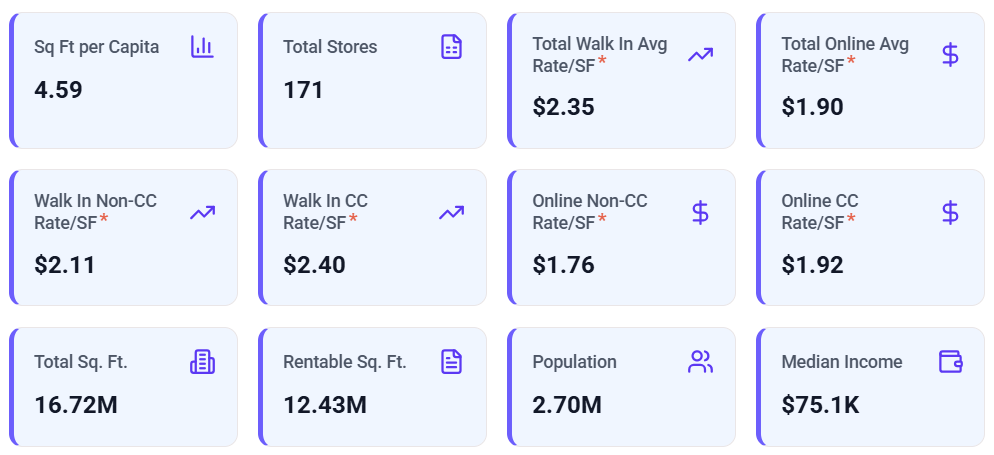
Chicago is a market where the underlying fundamentals tell a subtler story than pricing trends alone would suggest. The market is relatively mature with 12.4 million rentable square feet across 171 facilities and only one project currently under development. Yet despite this scale, Chicago remains structurally undersupplied at just 4.6 square feet per capita, equivalent to only 58% of the national average.
To better understand its potential as a self-storage investment, we used StorTrack’s Explorer platform to dig into key market metrics.
Market Snapshot for Chicago, IL
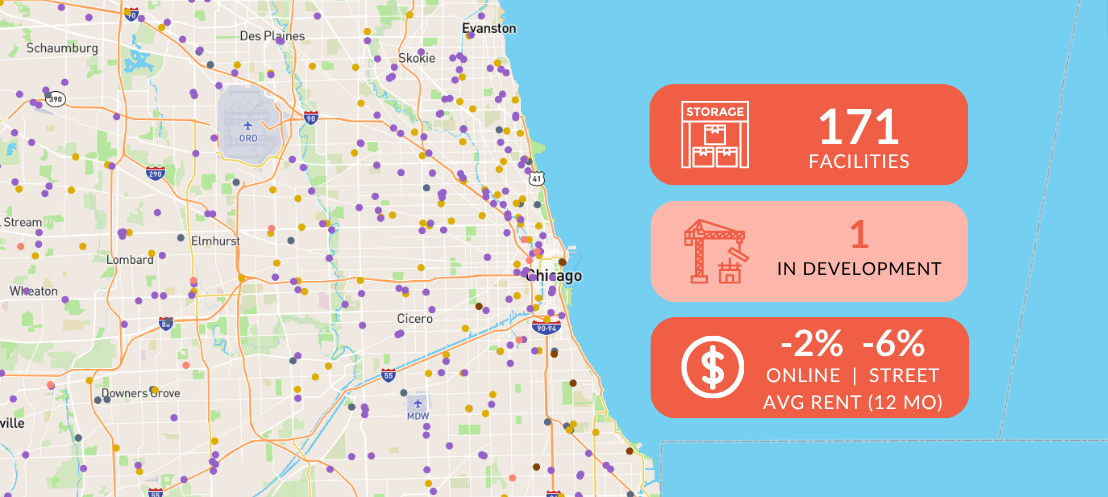
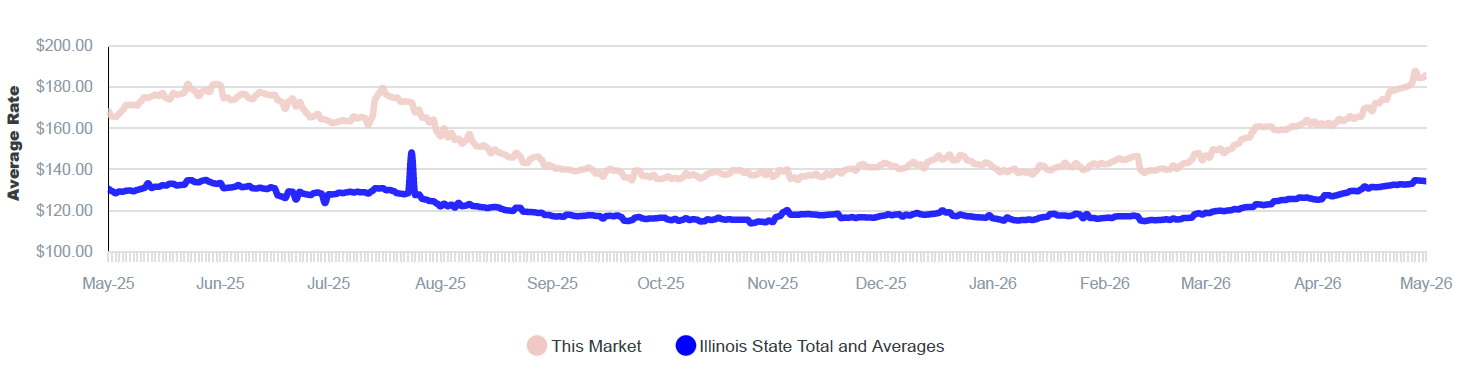
What makes the current environment particularly notable in Chicago, is that this long-term supply constraint has not translated into price momentum. Walk-in rates currently average $2.11 per square foot, down 5.5% over the trailing twelve months, while online rates of $1.76 per square foot have declined 2.3%. This differs markedly from the broader U.S. market, where pricing increased more than 5% during the same period, end at a national average of $1.27 per square foot.
Average Storage Rates in Chicago, IL
View the Free Report for Chicago ➝
The disconnect likely indicates a combination of slower housing activity and a wider competitive pricing pressure across the market over the past year. Even so, Chicago’s dense urban core, elevated renter population, smaller living spaces, steady population turnover and large student population across UIC, DePaul, Loyola and the University of Chicago continue to support stable storage demand. The diversified economy of the market, anchored by logistics, transportation, healthcare and small business activity, also provides a durable commercial demand base.
Key Market Metrics
Regulatory policy became an additional factor influencing market dynamics. In May 2025, Chicago restricted new self-storage development across most business and downtown areas, limiting future supply growth across the urban core. Long-term, constrained development, urban density, and a growing renter base will likely continue to support the market, with performance increasingly tied to pricing and occupancy management.
View the Free Report for Chicago ➝
📍Analyze Chicago—and Beyond
Want deeper insights on Chicago or other markets? Explore facility counts, rate trends, demographic shifts, new development activity and more with StorTrack’s Explorer platform.
🔍 Check Out Explorer for Market Analysis