Jupiter’s self-storage market is benefiting from a combination that’s becoming increasingly difficult to find: affluent population growth, constrained supply, and virtually no new development on the horizon. Within a five-mile radius of the town center, an estimated 102,000 residents are served by just 6.5 SF/capita of self-storage supply, below the national average of approximately 7.9 SF/capita.
We used StorTrack’s Explorer platform to dig into key market metrics.
Market Snapshot for Jupiter, FL
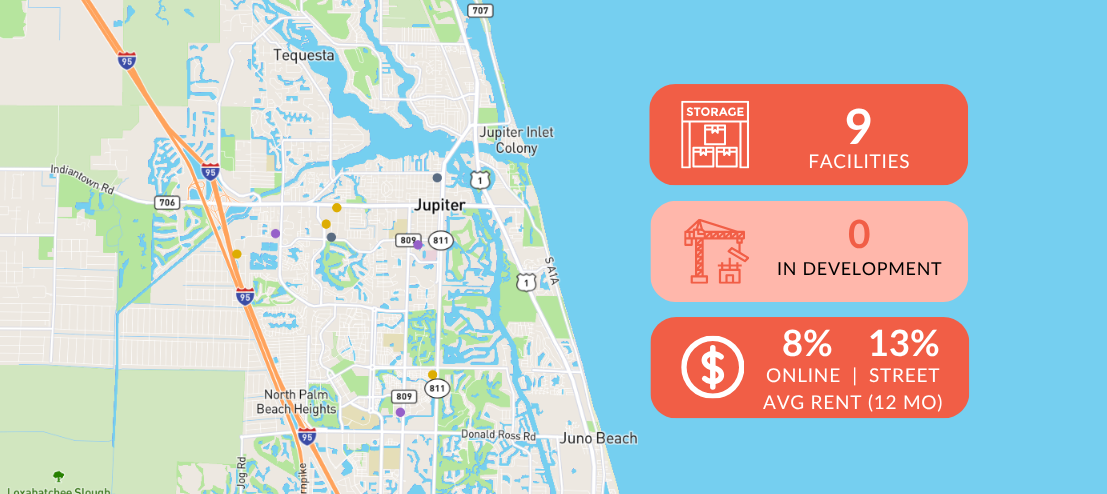
Over the next two years, the trade area’s population is projected to grow 2.16%, adding roughly 2,200 residents, while no new self-storage projects are currently in the pipeline. As a result, those new residents will be competing for the same fixed pool of storage capacity, reducing available SF/capita by approximately 2.14%. Importantly, that decline is driven entirely by population growth rather than a reduction in existing storage inventory, a dynamic that typically favors existing operators through high occupancy and pricing power. The trade area also includes approximately 8,457 renter households, representing about 20% of all households, and boasts a median household income of $134,030, a demographic profile that supports both sustained self-storage demand and the ability to absorb premium rental rates.
Beyond the area’s favorable demographics, Palm Beach County’s expanding economy continues to strengthen the market’s long-term demand outlook. Financial services, healthcare, luxury tourism, and real estate remain the region’s primary economic drivers, while continued expansion by firms such as Wells Fargo, Goldman Sachs, and D-Wave Quantum, combined with Florida’s advantageous tax climate and competitive corporate tax structure, continues to attract businesses and high-income households. That steady influx of new residents supports ongoing self-storage demand, particularly among renters and households transitioning to homeownership.
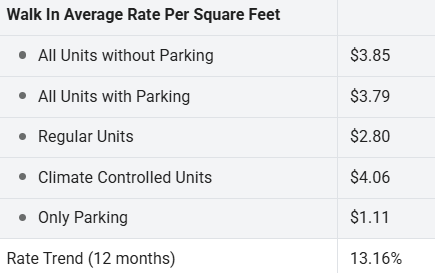
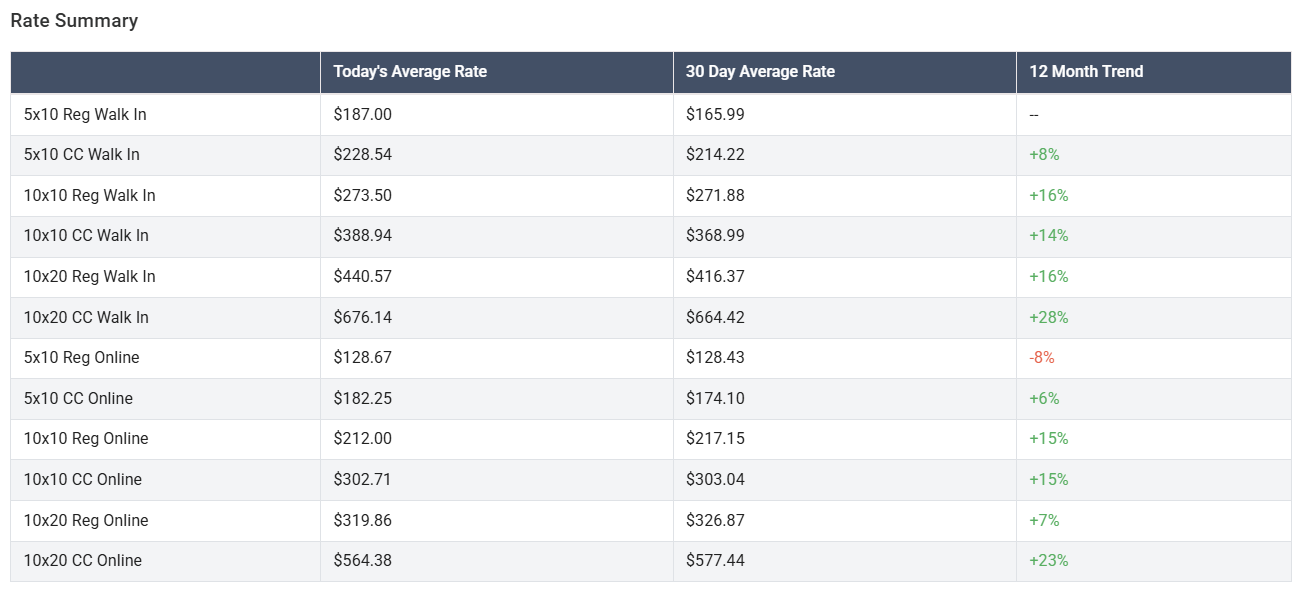
Pricing trends already reflect those underlying demand drivers. Over the past 12 months, average self-storage rents in Jupiter increased 13.1%, outperforming both the broader Miami-Fort Lauderdale-West Palm Beach MSA (11%) and the national average (1.7%). Average rental rates also remain approximately 30% to 40% higher than the surrounding MSA. Most benchmark unit sizes recorded annual rent growth between 6% and 28%, led by 10×20 units, where climate-controlled rents increased 28% and non-climate-controlled rents rose 16%. By comparison, 5×10 units were the lone exception, remaining flat or declining by as much as 8% over the same period.
View the Free Report for Jupiter, FL ➝
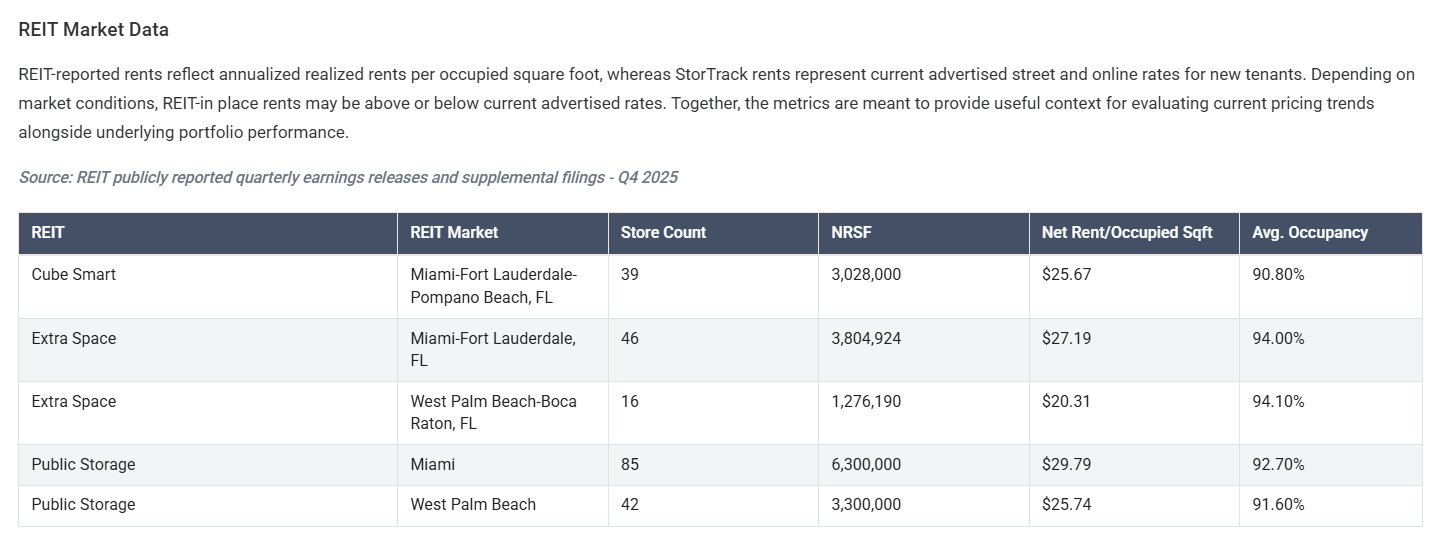
The market’s ownership profile reflects institutional investors’ confidence in Jupiter’s long-term fundamentals. REITs control 54% of existing self-storage properties, followed by large operators (30 or more stores) with 22%, while smaller and single-store operators account for approximately 17% of the market. Recent public REIT filings further underscore the area’s operating strength, with REIT-owned facilities across the MSA reporting occupancy levels above 90%.
Taken together, Jupiter stands out for the alignment of severable favorable market characteristics: above-average household incomes, steady population growth, limited self-storage supply, virtually no near-term development, and pricing that continues to outpace both the broader MSA and the national market. It’s a profile that illustrates how a small, high-barrier coastal submarket can diverge meaningfully from Florida’s broader self-storage supply boom – a divergence worth monitoring as statewide development activity continues to expand.
📍Analyze Jupiter, FL—and Beyond
Want deeper insights on Jupiter or other markets? Explore facility counts, rate trends, demographic shifts, new development activity and more with StorTrack’s Explorer platform.